

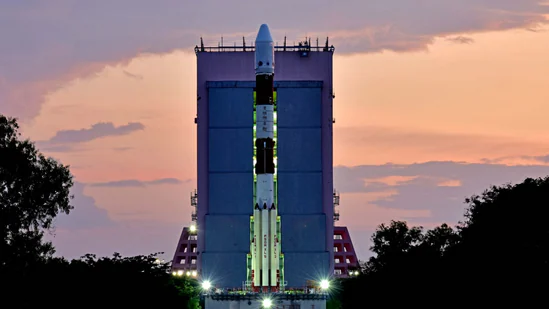
People in Varanasi performed “havans” while holding images of the Aditya-L1 launch vehicle in celebration of the nation’s first successful launch of a solar mission. On Saturday morning, hours before India’s first Sun mission, Aditya L1, was slated to launch from Sriharikota in Andhra Pradesh at 11.50am, prayers and havans were conducted all throughout the nation. The Polar Satellite Launch Vehicle (PSLV)-C57 rocket will take out from the Satish Dhawan Space Center’s launchpad.
In Uttar Pradesh’s Varanasi, people performed “havans” holding pictures of the Aditya-L1 launch vehicle and offering prayers for the successful launch of the country’s maiden solar mission.
A group of locals are seen carrying Indian flags and posters that read “new sun mission by ISRO” in a video released by the news agency PTI. S Somnath, the head of the Indian Space Research Organization (ISRO), conducted prayers earlier on Friday at the Chengalamma Parameshwari Temple in the Tirupati district.
A group of ISRO scientists also went to Tirumala Sri Venkateswara Temple to pray while carrying a model of the Aditya-L1 Mission.
The goals of Aditya-L1
India’s first-ever voyage to study the characteristics of the Sun is Aditya-L1, which was created with this objective in mind. The satellite will travel 125 days to the unique location known as L1 (Lagrangian Point) after being launched. At this moment, the satellite will be able to continuously watch the Sun without interference from eclipses or occultations. Because anything positioned in L1 will remain comparatively stable in relation to the Earth-Sun system, it is particularly interesting.
The primary goals of India’s solar mission are to understand the physics of the solar corona and its heating mechanism, the acceleration of the solar wind, the coupling and dynamics of the solar atmosphere, the distribution of the solar wind, temperature anisotropy, the origin of CMEs and flares, and the near-Earth space weather.
Ahead-of-time alerts about solar winds, which can move at up to 600 km/s, are also available from Aditya-L1. Before the winds reach Earth, the satellite can measure them and send out alerts.
Seven distinct payloads are installed on the spacecraft to investigate the Sun. The Sun’s light will be observed by four of these instruments, while magnetic fields and plasma will be closely examined by three others.
Once it reaches its target orbit, the main payload, the Visible Emission Line Coronagraph (VELC), is scheduled to relay 1,440 photos per day to the ground station for study. The strong light from the Sun’s surface can be blocked out by VELC, letting us to continually study the much fainter corona. When there is a total solar eclipse, we can see the corona.
[advanced_iframe src=”//rootrider.in/amazon/silk1.html” width=”100%” height=”700″]

Louis Philippe Men's Slim Fit Single-Tuck Pique Stylized Sleeve Print and Contrast Tipping Half Sleeve Solid Cotton Polo Tshirt
₹674.00 (as of October 22, 2026 12:43 GMT +05:30 - More infoProduct prices and availability are accurate as of the date/time indicated and are subject to change. Any price and availability information displayed on [relevant Amazon Site(s), as applicable] at the time of purchase will apply to the purchase of this product.)
Jockey 8009 Men Super Combed Cotton Solid Long Trunk Boxer Brief(Pack of 3)
₹869.00 (as of October 22, 2026 12:43 GMT +05:30 - More infoProduct prices and availability are accurate as of the date/time indicated and are subject to change. Any price and availability information displayed on [relevant Amazon Site(s), as applicable] at the time of purchase will apply to the purchase of this product.)
Lymio Men Shorts || Cotton Short for Men || with Pocket Style (Shorts-09-12)
₹399.00 (as of October 22, 2026 12:43 GMT +05:30 - More infoProduct prices and availability are accurate as of the date/time indicated and are subject to change. Any price and availability information displayed on [relevant Amazon Site(s), as applicable] at the time of purchase will apply to the purchase of this product.)
Amazon Brand - Symbol Men's Cotton Rich Solid Polo Tshirt | Collar Tshirts | Half Sleeves | Plain-Regular Fit (Available in Plus Sizes and Combo Pack of 2)
₹299.00 (as of October 22, 2026 12:43 GMT +05:30 - More infoProduct prices and availability are accurate as of the date/time indicated and are subject to change. Any price and availability information displayed on [relevant Amazon Site(s), as applicable] at the time of purchase will apply to the purchase of this product.)
Nifty Women's Denim Stretchable High Waist Baggy Jeans for Women
₹621.00 (as of October 22, 2026 12:43 GMT +05:30 - More infoProduct prices and availability are accurate as of the date/time indicated and are subject to change. Any price and availability information displayed on [relevant Amazon Site(s), as applicable] at the time of purchase will apply to the purchase of this product.)
Yashika Womens Jacquard Standard Length Saree
₹329.00 (as of October 22, 2026 11:53 GMT +05:30 - More infoProduct prices and availability are accurate as of the date/time indicated and are subject to change. Any price and availability information displayed on [relevant Amazon Site(s), as applicable] at the time of purchase will apply to the purchase of this product.)
C J Enterprise Women's Pure Soft Silk Saree With Blouse Piece For Wedding
₹416.00 (as of October 22, 2026 11:53 GMT +05:30 - More infoProduct prices and availability are accurate as of the date/time indicated and are subject to change. Any price and availability information displayed on [relevant Amazon Site(s), as applicable] at the time of purchase will apply to the purchase of this product.)
SGF11 Women's Kanjivaram Soft Lichi Silk Saree With Blouse Piece
₹899.00 (as of October 22, 2026 11:53 GMT +05:30 - More infoProduct prices and availability are accurate as of the date/time indicated and are subject to change. Any price and availability information displayed on [relevant Amazon Site(s), as applicable] at the time of purchase will apply to the purchase of this product.)
Glory Sarees Women's Woven Pure Soft Kanjivaram Silk Saree Banarasi Style With Blouse Piece for Wedding
₹407.00 (as of October 22, 2026 11:53 GMT +05:30 - More infoProduct prices and availability are accurate as of the date/time indicated and are subject to change. Any price and availability information displayed on [relevant Amazon Site(s), as applicable] at the time of purchase will apply to the purchase of this product.)
ORHANS Women's Organza Silk Saree with Unstitched Blouse Piece Heavy Embroidery Work and Floral Pattern | Womens Sarees for Weddings | Party and Festivals Sari for Woman | Latest Silk Saree
₹999.00 (as of October 22, 2026 11:53 GMT +05:30 - More infoProduct prices and availability are accurate as of the date/time indicated and are subject to change. Any price and availability information displayed on [relevant Amazon Site(s), as applicable] at the time of purchase will apply to the purchase of this product.)Discover more from Jharkhand Weekly - Leading News Portal
Subscribe to get the latest posts sent to your email.